
A headless CDP embedded into your messaging platform
Ingest data from any source, enrich with AI to predict intent, and activate across (almost) any channel — all from the same platform.
TRUSTED BY ENTERPRISE MARKETING TEAMS AT







CDP and activation should live under the same roof
Data lags and inconsistencies, resulting in mistakes like incorrect loyalty points or links to empty carts
Actual real-time updates. The moment a new data point is added, that change appears in activation.
AI “prediction” models are built using fragmented or incomplete data, resulting in personalization that doesn’t feel personalized.
Predict intent and understand buyer behavior, so you can send messages that drive tangible revenue outcomes.
Prediction models built using surface-level attributes, like browse behavior or purchase history.
Prediction models fed with rich data sources like in-store notes, support transcripts, product reviews, and more.
Data
When it comes to data, less is more
Ingest data from almost anywhere and store it for longer than anyone else — and then use it to send messages that actually convert.
- Feed personalization models with richer data than anyone, including unstructured data like in-store notes, product reviews, or support chats.
- Store data indefinitely: other marketing platforms store data for 30 days, which is not nearly enough time to understand someone.
- Build audiences in seconds, even with millions of contacts. Your audiences will be updated right up to the moment of send.
Identity Resolution
Unify Customer Profiles
Merge profiles with precise rules to make sure you have accurate data for each customer and that personalized messages go to the right person.
- Deterministic matching: Unify profiles with multiple email addresses or phone numbers.
- Better personalization: Consolidate buyer signals into a single profile to improve accuracy of AI predictive models.
- Deanonymize web visitors: Merge anonymous web visitors with known contacts.
Cordial AI™ Operating
Predict intent and decide next-best action
Build predictive models that work together to optimize every message you send. We have over 20 predictive models, including:
- AI Purchase Propensity, determines who is most likely to make a purchase.
- AI Discount Affinity, determines who is more likely to respond to a discount.
- AI Product Recommendations, determines which products an individual is most likely to purchase.
- plus 20+ more
Product Enrichment
Enrich product data to understand why products are bought
Two products may look identical to a typical product recommendation engine, even if purchase intent is wildly different. Cordial enriches product data to understand intent behind the purchase — and then uses that understanding to inform our AI product recommendation models.
Data Visualization
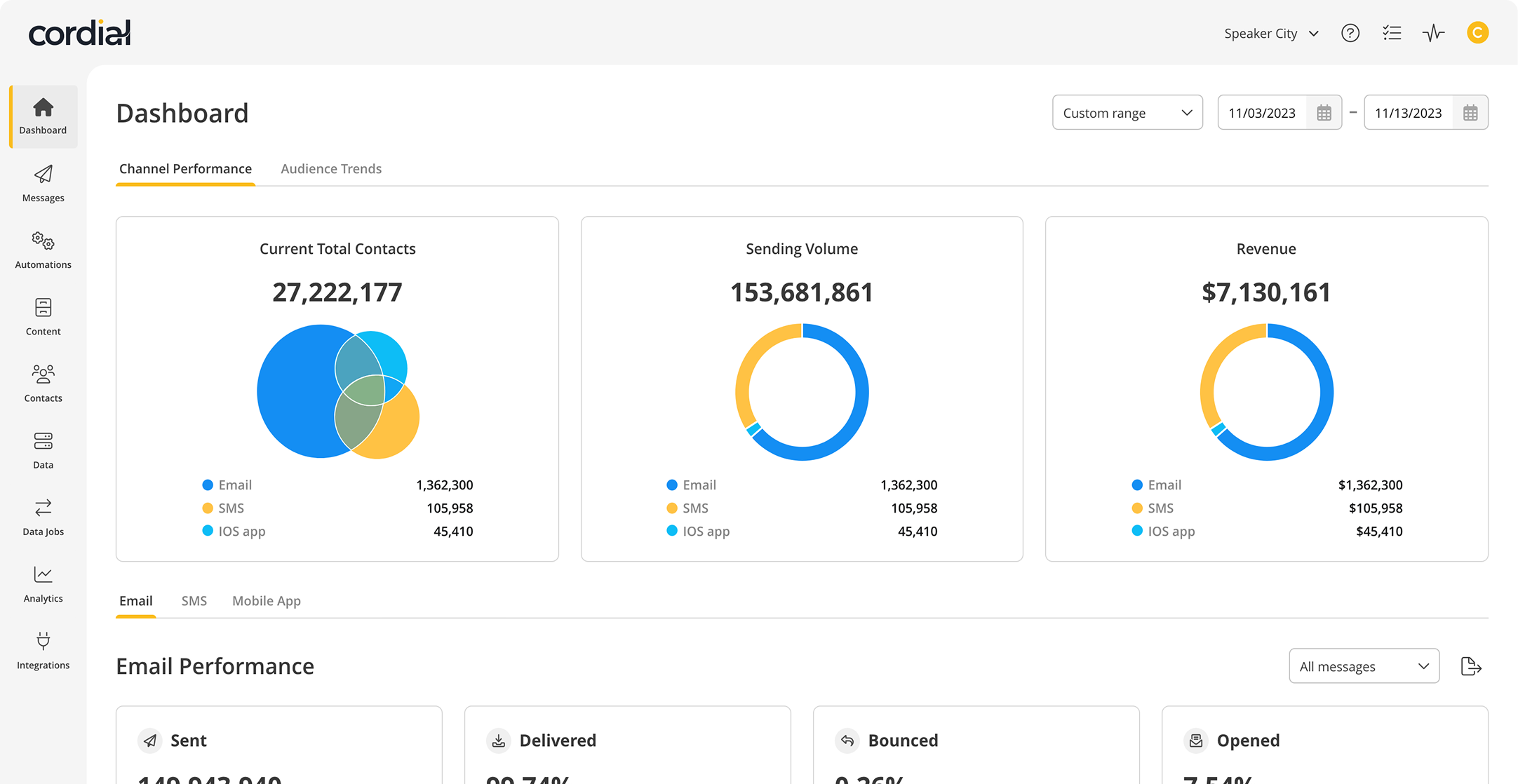
Visualize your data any way you’d like
Use natural language to build any type of graph, report, or analysis imaginable — without submitting a ticket to your data team.

Frequently asked questions
What is a headless CDP?
A headless CDP is a customer data platform that you can access directly from your preferred
How is a headless CDP different from a traditional CDP?
With a traditional CDP, you can access audience information within the CDP. But you’re not able to access the data from your AI assistants.
The biggest disadvantage to this is that you’re not able to easily access multiple different softwares from the same interface. With a traditional CDP, you can only access the data available within that UI. With a headless CDP, you can access all your data from your AI assistant — CDP data, message performance data, GA4 data, etc.
What is identity resolution and how does it work in a CDP?
Identity resolution is the process of merging scattered data points into a single, accurate profile for each customer, so personalized messages reach the right person. In a CDP it works by applying precise matching rules across the signals you collect. Cordial uses three main mechanisms:
- Deterministic matching unifies profiles that share multiple email addresses or phone numbers.
- Profile consolidation brings a customer's buyer signals into a single profile to improve the accuracy of AI predictive models.
- Web deanonymization merges anonymous website visitors with known contacts.
How does a CDP use AI to predict customer intent and next-best action?
A CDP uses AI predictive models to score each customer on likely behavior, then uses those scores to decide the next-best action for every message. Cordial runs more than 20 predictive models that work together to optimize every message you send, including:
- AI Purchase Propensity — who is most likely to make a purchase.
- AI Discount Affinity — who is more likely to respond to a discount.
- AI Product Recommendations — which products an individual is most likely to purchase.
Because the models work together rather than in isolation, you can layer signals — targeting someone with high purchase propensity but low discount affinity with a full-price message, while reserving discounts for customers who actually need them. The quality of these predictions depends on the data behind them: models fed with rich sources like in-store notes, support transcripts, and product reviews predict intent far better than models limited to surface-level browse or purchase history.
How long should a CDP store customer data?
A CDP should store customer data long enough to actually understand a person's behavior — which is far longer than the 30 days many marketing platforms default to. Cordial stores all relevant data indefinitely, because 30 days is not nearly enough time to understand someone's buying patterns, seasonality, or lifecycle. The principle here is that when it comes to data, less is not more: the more history you retain and the more sources you pull from, the better your personalization and predictions become.
Can a CDP ingest unstructured data like support chats and product reviews?
Not all CDPs are able to ingest unstructured data. Cordial’s CDP is able to ingest unstructured data (i.e. in-store notes, product reviews, and support chats) and use it to make personalization much richer. This matters because most personalization and "prediction" models are built on surface-level attributes like browse behavior or purchase history, which is exactly why they often don't feel personalized. Cordial feeds personalization models with richer data than typical platforms, including these unstructured sources, so predictions reflect what customers actually say and do rather than just what they click.
What is real-time activation and why does it matter?
Real-time activation means the instant a new data point is added, the change is immediately reflected in your audiences and message personalization.
In contrast, data lags can result in things like:
- Sending a link to an empty cart (if someone purchases their cart before your abandoned cart trigger fires)
- Sending a message with outdated loyalty points (if someone makes a purchase before your scheduled message)
- Sending a winback message (after someone has already made the purchase)
How can a CDP deanonymize anonymous website visitors?
A CDP deanonymizes anonymous website visitors by merging their activity with known contacts through identity resolution. In practice, a visitor often browses your site before they're identified, building up behavioral signals under an anonymous profile. When that person later provides an identifier — logs in, makes a purchase, or clicks a known email link — Cordial's identity resolution merges the anonymous web visitor with the known contact, so all of that earlier browsing history is attached to the real profile.
This works alongside deterministic matching, which unifies profiles that share multiple email addresses or phone numbers, and profile consolidation, which brings scattered buyer signals into a single profile.
Can I use Cordial’s CDP to analyze customer data and build reports without my data team?
Yes, Cordial lets you use plain language to build any type of graph, report, or analysis imaginable via the Cordial MCP. Unlike other CDPs, you can then activate this data — both through the Cordial interface or via your AI assistant (the “headless” part of the headless CDP).
Ready to learn more?
Get a demo